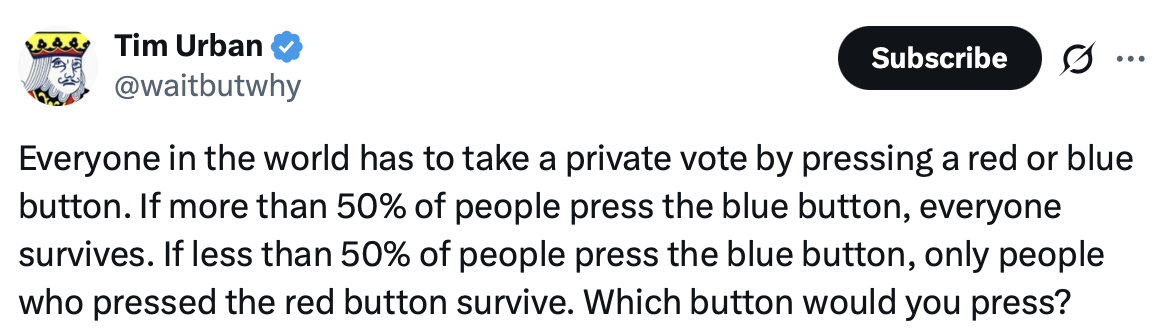
If more than 50% press the blue button, everyone survives. Otherwise, only red button pressers survive.
I think it’s immoral to encourage people to press the blue button.
The prompt
The possible outcomes
Before I explain my view, let’s establish a baseline understanding of the possible outcomes. Predicting the likeliest outcome becomes a game of psychology, and depends on your beliefs around other people’s worldview.
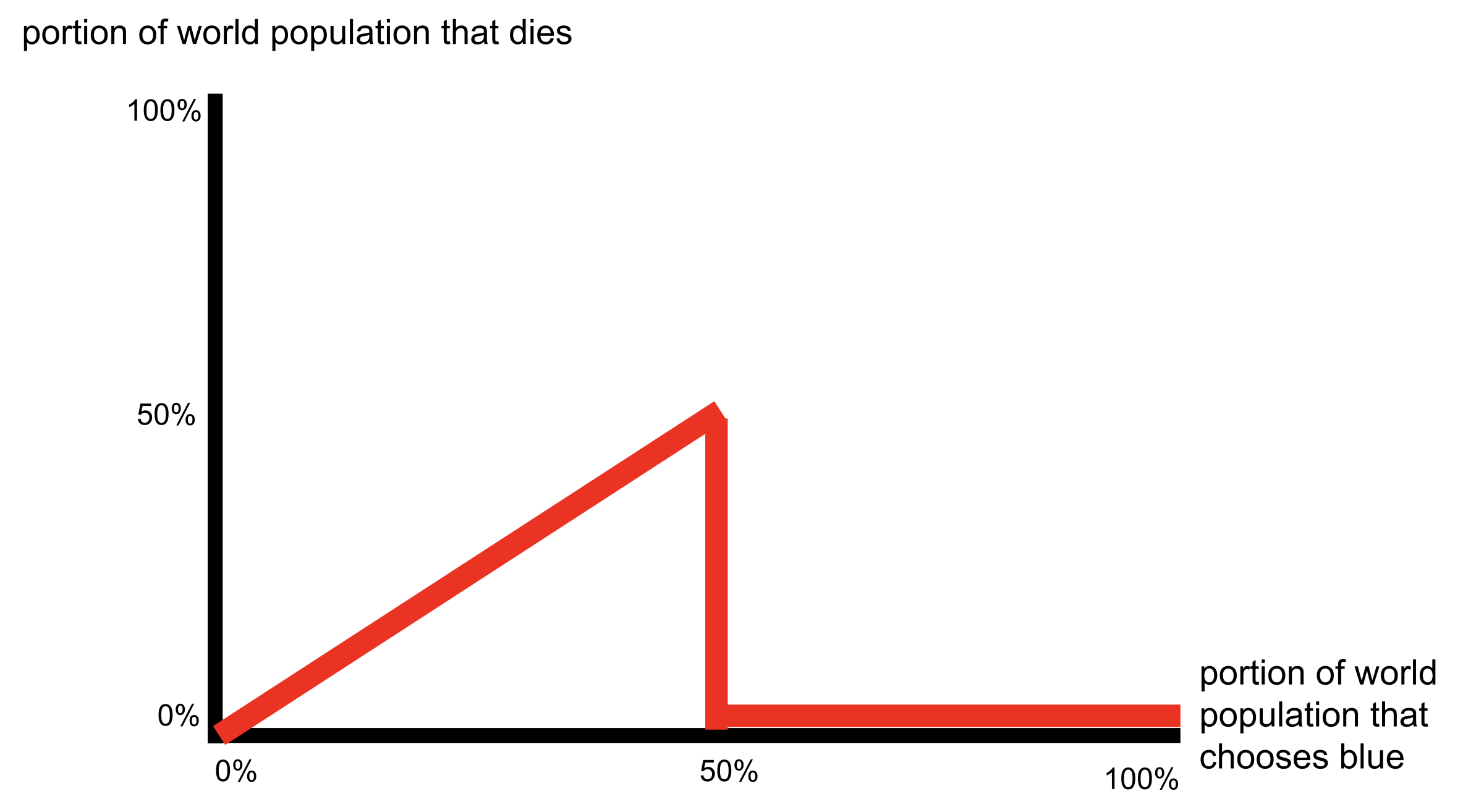
So clearly the worst possible outcome is one in which nearly 50% of people select blue, but not quite 50%. Then, nearly half of the world dies.
The best possible outcome is one in which zero people die, and we can see there are two ways that can happen:
- no one selects blue
- 50% or more select blue
We can think about how one’s selection of their perceived correct decision depends on their prediction of what others will choose.
If you think there’s a:
- 10% chance that exactly 20% will choose blue, and a
- 20% chance that exactly 45% will choose blue, and a
- 30% chance that exactly 60% will choose blue, and a
- 40% chance that exactly 70% will choose blue
then the expected number of deaths (where TP=Total Population) is (.1 * .2 * TP) + (.2 * .45 * TP) + (.3 * 0 * TP) + (.4 * 0 * TP) = .11 * TP = 11% of the total population.
So in that case, you think the most likely outcome is that more than 50% choose blue, but in your head there’s still a 30% chance that fewer than 50% choose blue, and some large portion of the population would die in that case.
Of course, in reality, one would be making predictions based on continuous ranges of probabilities, not four discrete buckets, but this is just for the sake of illustration.
Simply: I believe the average person cares a lot about their own life and the lives of their loved ones
My belief is that it’s very unlikely that more than 50% would select blue, regardless of how hard people push each other to go all in on selecting blue.
We can see the empirical results from the poll on X:

So you might be thinking, wow, well Kyle must be wrong. We can see that more than 50% selected blue. I think this is totally fallacious:
People are answering from the comfort of their bed, scrolling on their phone in a safe and comfortable environment, casually thinking about an interesting hypothetical. They’re likely thinking about what the “correct” decision is rather than what their actual decision would be.
I think if people’s actual lives were on the line, they would be dramatically less likely to choose the seemingly pro-social cooperative option.
The fact that even given the above, it was only 8% above the cutoff should give the reader a lot of pause.
Every person you encourage to choose blue is a potential life lost, every person you encourage to choose red will survive regardless of the outcome
Let’s say you look at the above poll results and say, well OK I buy that people might be slightly less likely to choose blue in the real world, but I still think it’s most likely that > 50% will choose blue.
But do you think there’s still a 10% possibility that < 50% will choose blue?
If so, would you tell a loved one, who trusts you as a wise decision-maker, to choose blue? Would you accept that there’s a 10% chance that they will die? If you tell them to choose red, they will survive either way.
Every parent in the world would be performing the above calculus, consciously or not.
An alternative framing 🔫
Every person in the world is provided a gun. If a person wants to, they can shoot themselves in the head. However, these guns are special so that if more than 50% people in the world shoot themselves in the head, the guns will all jam and everyone will survive. Or, the person can choose to set the gun down and walk away.
I believe that the above is an equivalent hypothetical to the original prompt. The outcomes and options are identical, it’s just the framing is different:
- Selecting a blue pill from the original prompt == Shooting oneself in the new prompt
- Selecting a red pill from the original prompt == Setting the gun down in the new prompt
Now it is different because the framing is much more violent, so that will sway your understanding of what other people will select. But I think because the outcomes are the same – namely people’s lives being on the line when they make a decision – that it won’t sway the outcome dramatically.
With this framing, it becomes more clear – encouraging someone to shoot themselves feels scary, immoral, almost sinister. Sure, there will be a saving grace if more than 50% choose to do it. But why risk that? Why not tell them not to gamble their lives like that?
The case for the blue button
The argument for the blue button goes something like the following:
- Sure, maybe the nash equilibrium for this scenario is for everyone to select red and then no one dies.
- But people are irrational, ill-informed, confused, or deeply altruistic and want to help others as much as they can.
- So because we know that some people will select blue, even though they “don’t need to,” we – as rational and kind decision-makers – should save their lives by also selecting blue and ensuring everyone survives.
I think this has merit, it’s true that not everyone behaves like a poker player in an undergrad game theory course, and it’d be good to try to protect those who are not perfect decision makers.
What I think is truly incorrect, though, is that getting to > 50% is at all possible. The world is not composed of people who are reading philosophy textbooks and gaming out the possible outcomes. It’s composed of people who want to continue living, and want to protect their loved ones from harm.
With this understanding, every person we encourage to select blue is a life lost to an incredibly unlikely goal of reaching 50%. Every person we encourage to select red is a life saved.